Why Take an Online IQ Test?
Have you ever wondered how fast your brain picks up patterns, solves visual puzzles, or processes logic problems under pressure? Curiosity is a fundamental human trait. Whether you're preparing for a job assessment, looking to challenge your problem-solving skills, or simply wanting a fun brain stretch on your lunch break, an online IQ test gives you an engaging window into your mental agility.
Traditional clinical intelligence evaluations usually involve hours of seated testing with a licensed psychologist. They're thorough, but they can also cost hundreds of dollars and require advance appointments. Our free online IQ test was created to give you a quick, accessible, and enjoyable way to gauge your problem-solving speed and logical reasoning across multiple categories — right from your browser, completely free of charge.
Every time you start a test session, our system pulls 20 randomized questions from our extensive pool of 1,000 unique questions. That means you won't get stuck doing the exact same quiz twice if you return to test your skills again later!
What Our 20-Question Assessment Measures
Intelligence isn't just a single isolated talent — it's a rich composite of diverse mental abilities. To give you a well-rounded estimate of your problem-solving skills, our quiz draws questions from nine distinct cognitive domains:
- Logic & Deductive Reasoning: Testing your ability to analyze premises, evaluate conditional statements, and reach valid logical conclusions without falling for fallacies.
- Pattern Recognition: Spotting subtle visual rules, numerical sequences, and ordering principles buried inside complex data sets.
- Verbal Reasoning: Evaluating your grasp of vocabulary, verbal analogies, contextual nuances, and conceptual relationships between words.
- Spatial Reasoning: Mental rotation, folding 3D shapes, visualizing symmetry, and understanding how objects interact in space.
- Memory & Knowledge: Recalling key facts, working memory retrieval, and rapidly synthesizing general knowledge under timed constraints.
- Analogies: Identifying proportional relationships between paired items and transferring those abstract concepts to new situations.
- Problem Solving: Tackling practical real-world scenarios, multi-step math problems, and situational logic puzzles.
- Mathematics: Quantitative reasoning, basic algebra, arithmetic estimations, and numerical logic.
- Sequences: Detecting patterns across alphabetic, numeric, and symbolic series to accurately predict the next item.
By blending these categories into a 30-second-per-question format, the test evaluates not only your raw accuracy but also your cognitive processing speed. Quick decision-making under time constraints reflects working memory efficiency, which is a core component of fluid intelligence.
How IQ Scores Work: Calculation & Scale
Standardized intelligence tests measure performance relative to the general population using a bell-shaped normal distribution curve. On this bell curve, the median score is set to 100, with a standard deviation of 15 points.
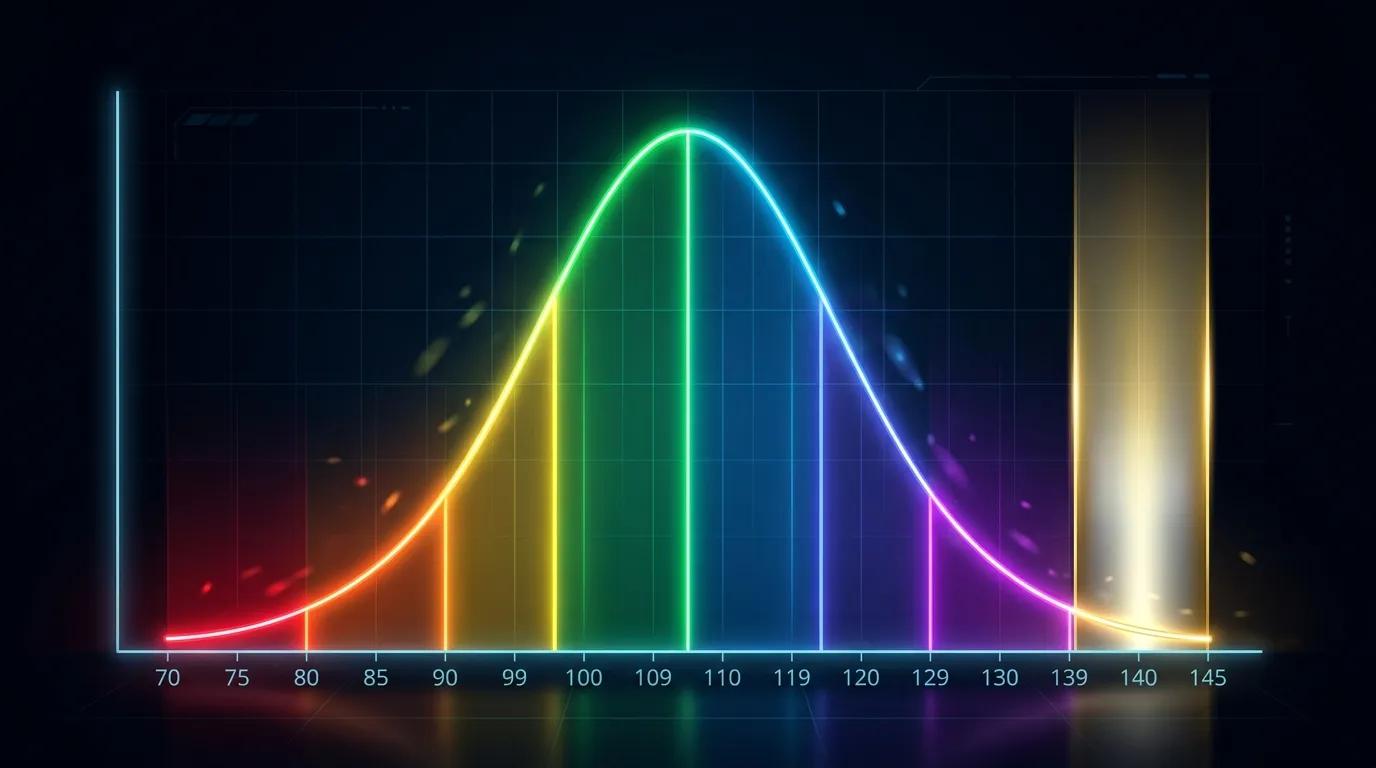
Here's how IQ scores break down across the general population:
- 130 and above (Top 2.2%): Very Superior or Genius level. High mental speed, abstract reasoning, and complex pattern detection.
- 120 – 129 (Top 9%): Superior. Excellent analytical thinking and strong spatial and mathematical ability.
- 110 – 119 (High Average): Above average cognitive capability, quick learning speed, and reliable problem solving.
- 90 – 109 (Average, ~50% of people): Standard cognitive performance across logic, memory, and spatial tasks.
- 80 – 89 (Low Average): Slightly below population average, but well within typical functional ranges.
- Below 80: Lower performance tier on standardized measures.
When you finish our test, our algorithm evaluates your accuracy alongside the relative difficulty rating of each question you answered. It then maps your performance to this standard IQ distribution scale so you can see where your score sits relative to global percentiles.
A Brief History of Intelligence Testing
The concept of measuring human intelligence dates back to the early 20th century. French psychologist Alfred Binet developed the first practical intelligence test in 1905 to identify schoolchildren needing extra academic support. Binet's test introduced the idea of "mental age."
Later, German psychologist William Stern coined the term Intelligence Quotient (IQ), calculated by dividing mental age by chronological age and multiplying by 100. In the 1930s, David Wechsler revolutionized testing by introducing standard deviation scores based on population norms — creating the foundation for tests like the WAIS (Wechsler Adult Intelligence Scale) used today.
Modern digital assessments like ours build on these classic principles. While online quizzes aren't a replacement for comprehensive psychological evaluations, they utilize similar logic and pattern frameworks to deliver fast, engaging feedback on your cognitive performance.
Can You Actually Improve Your IQ Score?
A common question people ask is whether intelligence is fixed at birth or if you can actively train your brain to score higher. Psychologists split intelligence into two main types: fluid intelligence (the ability to reason, spot patterns, and solve novel problems) and crystallized intelligence (accumulated knowledge, vocabulary, and learned skills).
While crystallized intelligence grows steadily throughout your life as you read, study, and gain experience, fluid intelligence was long thought to be mostly set by genetics. However, research into neuroplasticity shows that targeted cognitive training can sharpen working memory, visual processing, and focus.
- Get Quality Sleep: Deep sleep clears metabolic waste from the brain and consolidates working memory.
- Practice Pattern Puzzles: Sudoku, chess, crosswords, and logic puzzles build mental agility.
- Exercise Regularly: Aerobic exercise boosts blood flow and stimulates neurogenesis in the hippocampus.
- Stay Curious: Learning new languages or instruments builds fresh neural pathways throughout life.
Frequently Asked Questions
Is this online IQ test completely free?
Yes, 100%! You can take the entire 20-question quiz, view your complete IQ score, accuracy percentages, category breakdowns, and time stats without paying a dime or creating an account.
How accurate is an online IQ test compared to an official clinical exam?
Our online test is designed for entertainment, self-assessment, and mental exercise. While it uses validated cognitive test question types (logic, patterns, spatial, verbal), official clinical assessments like the WAIS-IV are administered in person by licensed psychologists and take several hours. Use your score here as a fun, informative estimate rather than a medical diagnosis.
Why is there a 30-second time limit per question?
Processing speed is a key metric of fluid intelligence and working memory. The 30-second timer encourages quick intuitive thinking and keeps the quiz fast-paced and exciting, taking less than 10 minutes total.
Can I retake the test to improve my score?
Absolutely! Each test pull randomly selects 20 questions from our 1,000-item bank. Retaking the test will present you with fresh questions, giving you a new opportunity to challenge your speed and accuracy.
What is considered a good IQ score?
An IQ score of 100 is exact population average. Scores between 90 and 109 represent average intelligence, while scores of 115 or higher place you in the top 16% of test takers. Scores over 130 represent the top 2% of the population.